Shopify peptide store shut down: emergency migration & payment setup.
If your Shopify peptide store shut down or faced payment processor suspension, we provide rapid migration to an independent custom architecture. This service provides structured catalog data extraction, batch COA mapping, customer account transition, and 1-to-1 301 redirect architecture to move your peptide store to a compliant, self-owned platform without sacrificing historical data or search visibility. Searches like “migrate peptide store off Shopify” and “WooCommerce peptide migration” describe the same job: a peptide website migration that keeps the catalog, the COAs and the rankings.
Direct Payment Gateway Freedom
Connect dedicated high-risk merchant accounts (NMI, Authorize.net) directly without hosted platform restrictions, third-party gateway surcharges, or automated aggregator account shutdowns.
1-to-1 301 Redirect SEO Protection
Every legacy Shopify URL (/products/*, /collections/*, /pages/*) is mapped to its exact destination with edge-level 301 permanent redirects, preserving Google search rankings and indexed backlinks.
Complete SKU & Variant Migration
Extract all product titles, descriptions, vial sizes, reconstituent pairings, batch numbers, and pricing tiers into a structured catalog with zero manual re-entry errors.
Batch-Specific COA Document Mapping
Link third-party analytical laboratory test reports (HPLC and Mass Spectrometry) directly to each compound SKU, searchable by lot number for immediate buyer verification.
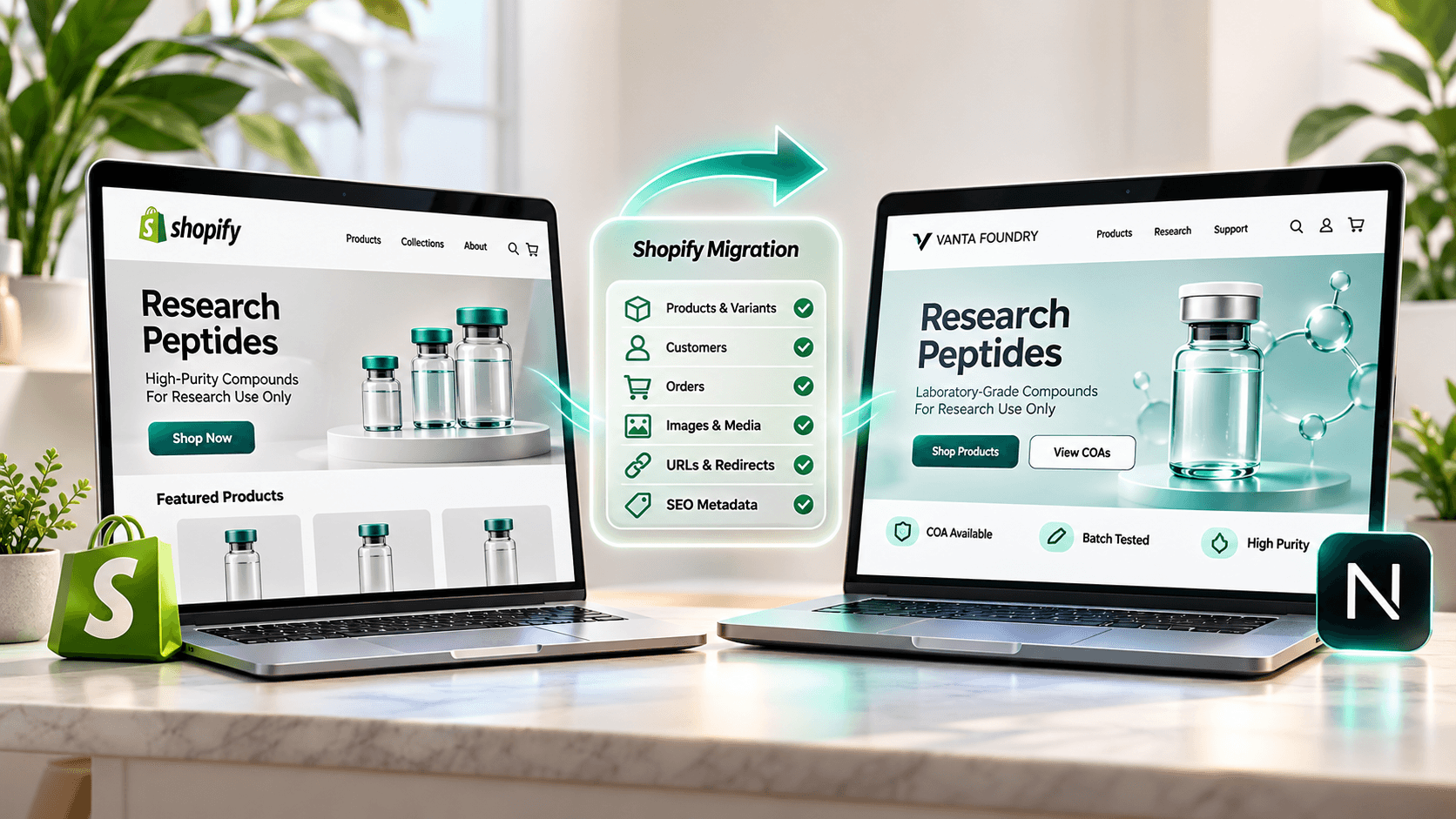
Why do research chemical brands plan a Shopify migration?
The Hosted Platform Conflict
Shopify operates as a closed SaaS ecosystem with centralized acceptable use policies. While selling laboratory supplies is not universally barred, Shopify Payments relies on banking agreements that strictly prohibit research peptides, unapproved compounds, and related specialty chemicals. When automated crawlers flag a store, accounts are often suspended on short notice, halting payouts and customer checkout simultaneously.
Gateway Surcharges & App Restrictions
While Shopify permits third-party payment gateways in theory, it imposes an additional 0.5% to 2.0% transaction fee on every sale not processed through Shopify Payments. Furthermore, hosted platforms restrict custom checkout modification, preventing advanced payment routing, dual-MID backup failover, and mandatory research-consent validation scripts required by strict acquiring bank underwriters.
Systematic Process
Shopify-to-Custom Migration Workflow
A structured 5-stage transition engineered to safeguard your product catalog, historical customer accounts, and organic search rankings with thorough staging validation before cutover.
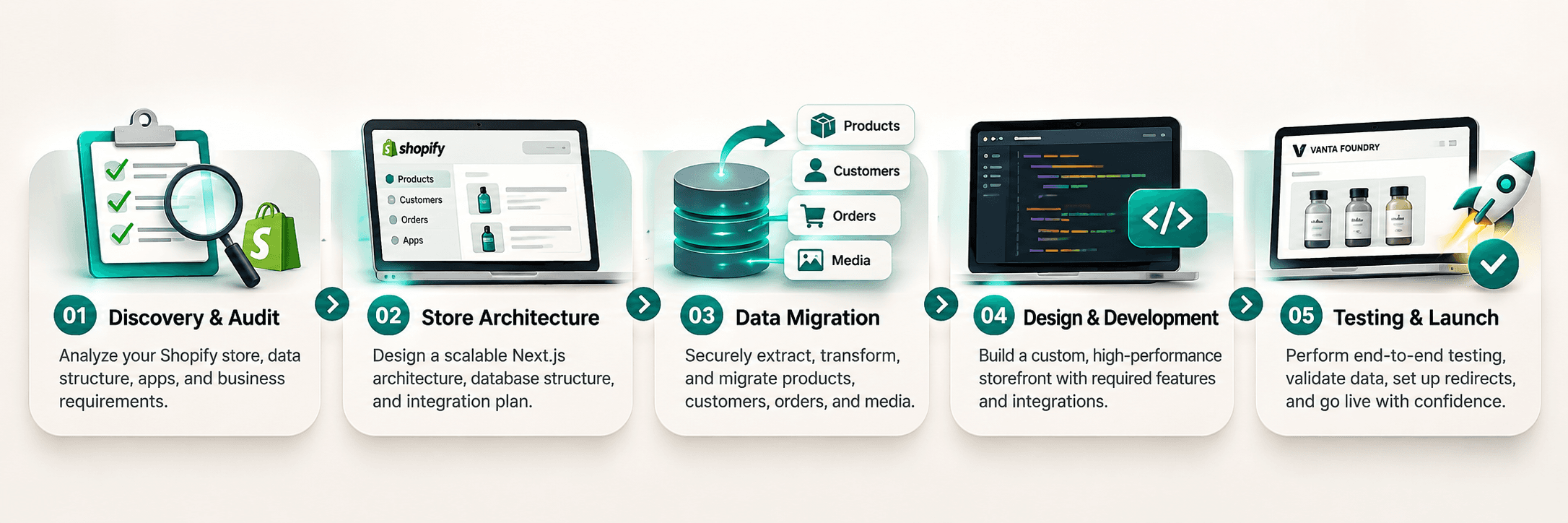
Discovery & Audit
Days 1–3Crawl published Shopify catalog, index existing URLs, and audit third-party apps.
Store Architecture
Days 4–7Configure custom Next.js database models, RUO compliance gates, and payment endpoints.
Data Migration
Days 8–12Extract products, variants, customer records, and pair lot-verified analytical COA PDFs.
Design & Development
Days 13–18Deploy responsive storefront components, sub-second speed tuning, and mobile UX.
Testing & Launch
Days 19–21Perform live gateway sandbox transactions, deploy 301 redirects, and execute DNS cutover.
Objective Evaluation
Platform Comparison: Shopify vs. Custom Next.js Commerce
A balanced technical analysis of control, payment architectures, compliance flexibility, and maintenance overhead for specialized research supply operations.
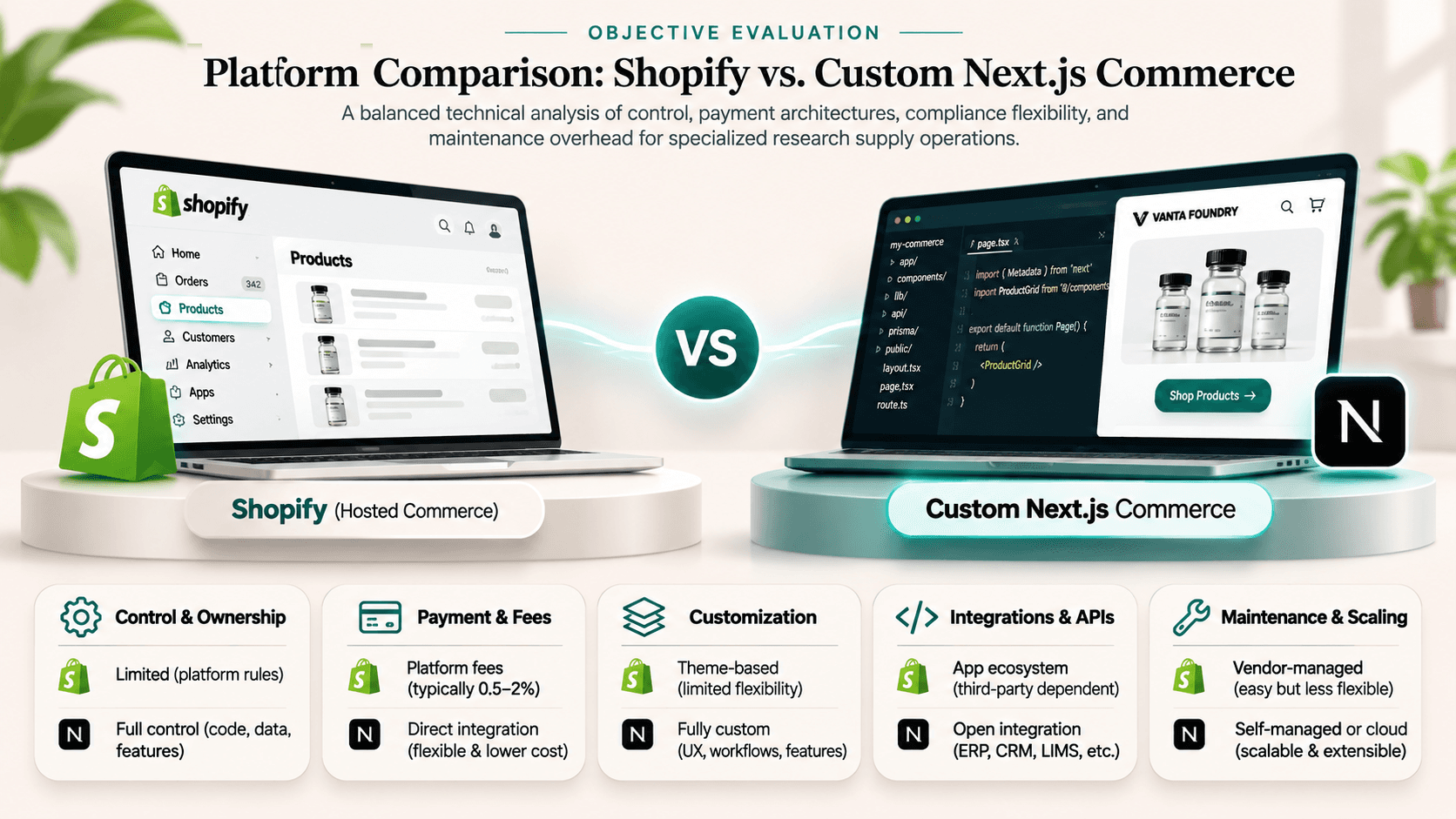
Platform Control & Governance
Closed proprietary ecosystem. Stores are subject to global Acceptable Use Policies and automated compliance screening crawlers, which can suspend checkout without prior notification.
Complete source code and database ownership. Hosted on independent cloud infrastructure (Vercel, AWS) with zero centralized policy enforcement or platform shutdown risk.
Payment Gateway Architecture
Shopify Payments prohibits research peptides. Connecting external gateways triggers additional 0.5%–2.0% third-party platform transaction surcharges on all gross sales.
Direct API integration with dedicated high-risk gateways (NMI, Authorize.net). 0% platform transaction penalties, native dual-MID failover routing, and custom fraud filters.
Customization & Regulatory Workflow
Restricted by Liquid templating and hosted app sandbox limits. Custom lot-number COA search tools and mandatory research consent gates require complex third-party apps.
Bespoke interactive COA search engines, batch test verification lookup by lot ID, and legally binding, unchecked Research Use Only checkout acknowledgment scripts.
Integration & API Extensibility
Reliant on pre-approved Shopify App Store modules. Deep database hooks, custom ERP syncs, and proprietary laboratory API integrations are constrained by API rate limits.
Direct programmatic connection to analytical laboratory databases, ERPs, warehouse fulfillment APIs, and CRM platforms with zero middleware restrictions.
Ownership, Hosting & Maintenance
Turnkey managed hosting with automated security updates, patches, and CDN scaling. No DevOps or server engineering required, but perpetual software lock-in.
Unmatched speed with edge serverless rendering and global CDN caching. Requires developer maintenance for updates, hosting configuration, and deployment pipelines.
Strategic Assessment Summary
Neither platform is universally superior. Shopify remains an exceptional turnkey solution for standard retail commerce with low technical overhead. However, for specialized research peptide enterprises that require direct merchant accounts without 0.5%–2.0% gateway penalties, custom COA verification search engines, and absolute immunity from abrupt hosted account suspensions, Custom Next.js Commerce offers long-term operational resilience and full codebase ownership.
Data Architecture
Structured 4-Stage Data Migration Pipeline
How catalog entities, batch test reports, past customer records, and indexed SEO structures transition from Shopify into your new architecture.
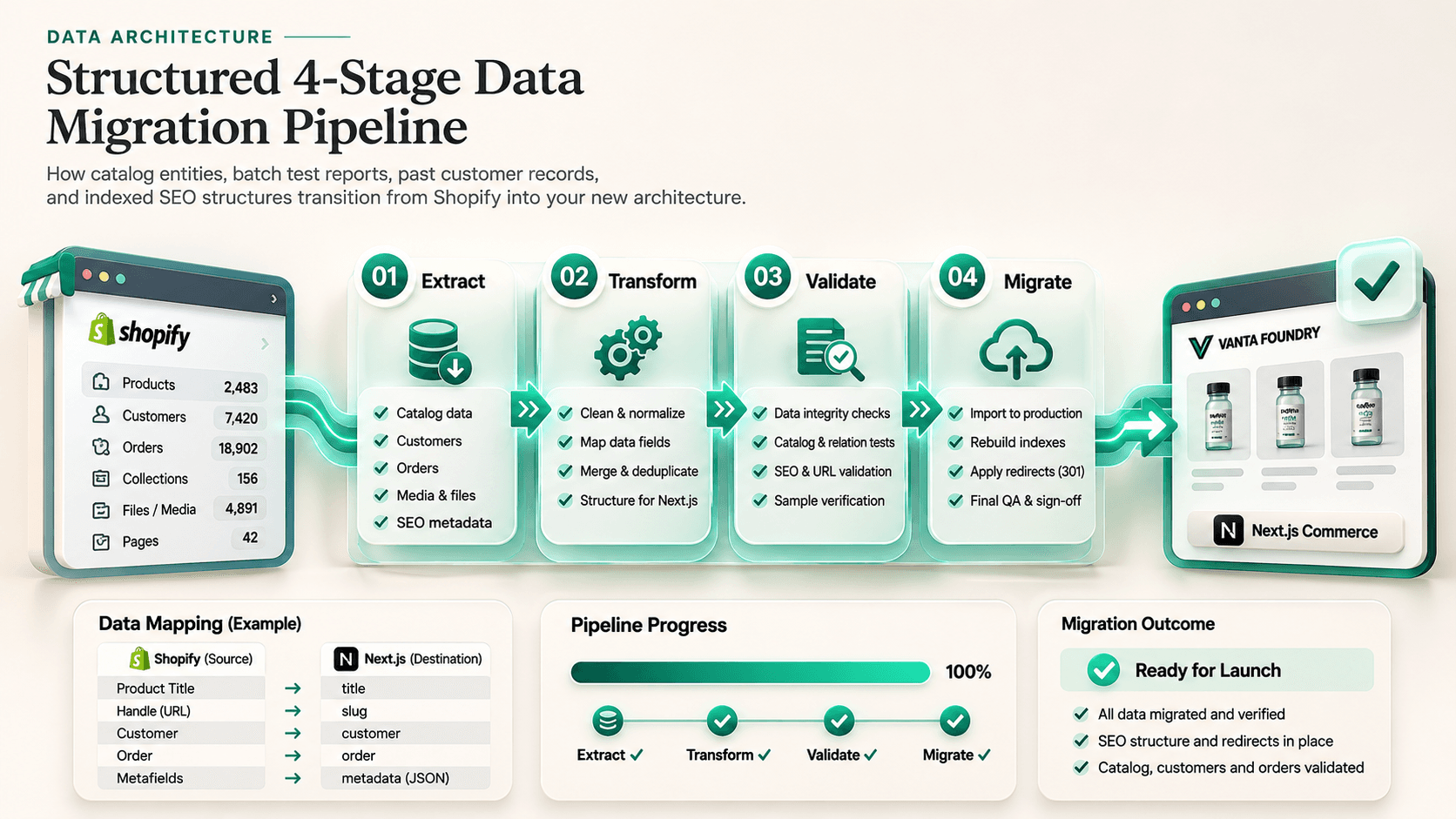
Shopify Store API
REST & GraphQL extraction of products, collections, media assets, and customers.
Data Mapping Engine
Transforms raw JSON into relational schema; maps vial sizes, CAS numbers, and lot numbers.
Integrity QA & Pairing
HPLC lab PDF attachment, 301 redirection match verification, and AVS test audits.
Custom Target Platform
Ingestion into production database with sub-second caching and direct gateway routing.
Six Preserved Data Entities
Products & Chemical Variants
- Compound names, synonyms & formulas
- Vial sizes (e.g. 5mg, 10mg, 50mg)
- Batch lot numbers & stock inventories
- Pricing tiers & wholesale bundle packs
Customer Profiles & Addresses
- Full customer names & email records
- Billing and shipping address histories
- Telephone numbers & contact preferences
- Institutional vs retail account tags
Historical Orders & Invoices
- Past order IDs, dates & itemized lines
- Gross transaction amounts & tax records
- Fulfillment statuses & tracking numbers
- Archived order documentation
Product Media & Vial Photography
- High-resolution vial & packaging images
- Chemical molecular structure diagrams
- Image ALT tags & SEO file naming
- Fast Next.js WebP/AVIF CDN distribution
URL Hierarchy & 301 Redirects
- Every legacy /products/* path mapped
- Every collection /collections/* mapped
- Information & compliance pages mapped
- Edge-deployed permanent 301 redirect matrix
SEO Metadata & Structured Data
- Page title tags & meta descriptions
- Canonical URL tags & OpenGraph cards
- Product & Organization Schema markup
- Updated XML sitemap submitted to Google
Customer Password Portability & Security Constraints
Shopify enforces strict financial-grade security standards by hashing user passwords with irreversible cryptographic algorithms (bcrypt/PBKDF2). Consequently, no developer or migration service can extract plaintext passwords from Shopify's database. To provide a seamless customer transition, all customer profiles, past order records, and shipping addresses are migrated intact, and customers receive an automated, branded single-click activation link upon launch to set their new password without losing historical purchase data.
Telemetry & Verification
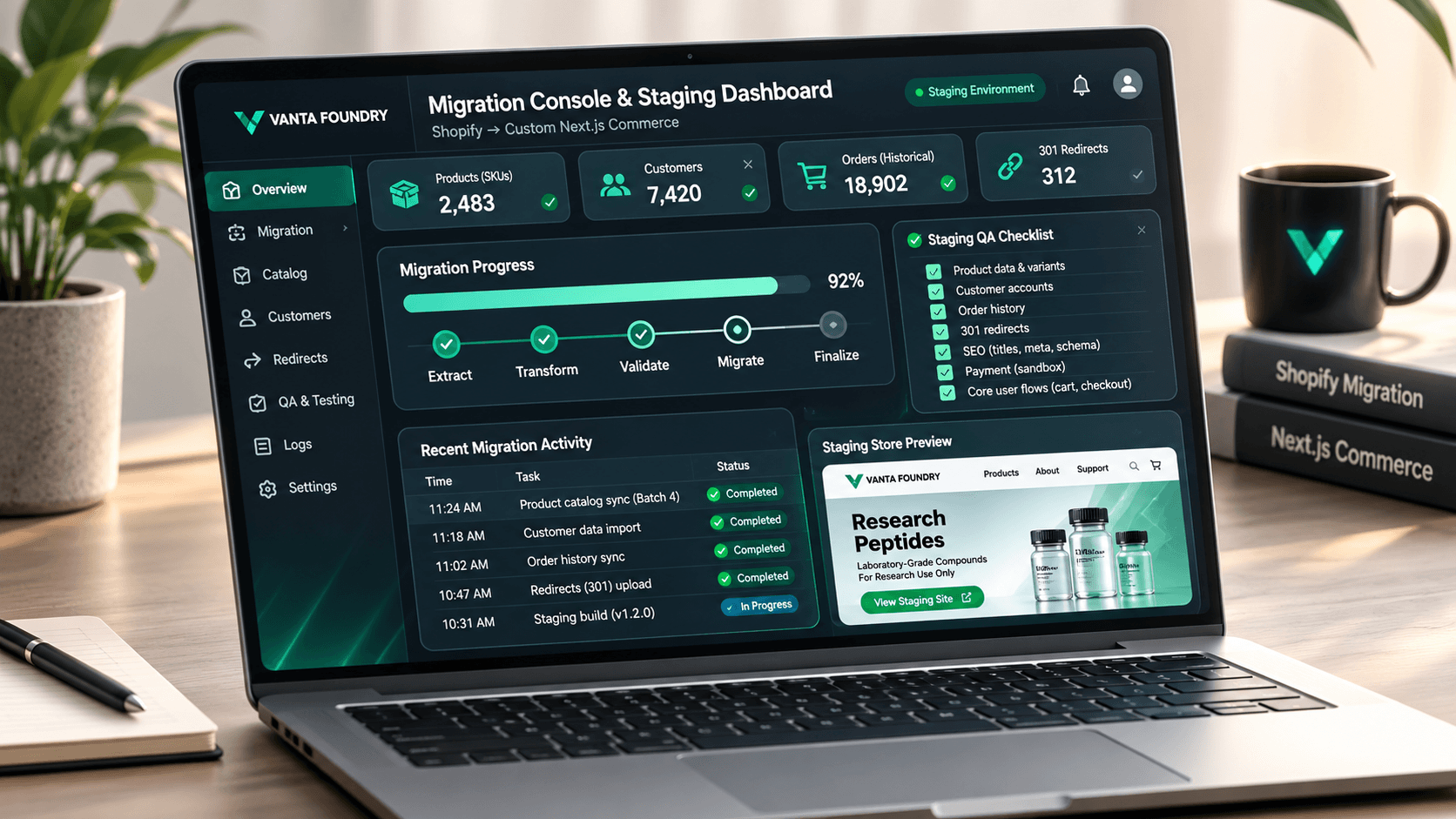
Migration Console & Staging Dashboard
An illustrative preview of our staging environment console used to monitor SKU mapping, analytical COA pairings, 301 redirection rules, and pre-flight payment QA.
| SKU | Compound & Form | CAS # | COA Verification | Payment MID | Status |
|---|---|---|---|---|---|
| REF-CMPD-01 | REF-CMPD-01 — Analytical Reference Standard | 137525-51-0 | HPLC + MS Verified | Mapped to MID-1 | Validated |
| REF-CMPD-02 | REF-CMPD-02 — Lyophilized Reference Material | 885340-08-9 | HPLC + MS Verified | Mapped to MID-1 | Validated |
| REF-CMPD-03 | REF-CMPD-03 — Laboratory Research Compound | 49557-75-7 | HPLC + MS Verified | Mapped to MID-1 | Validated |
| REF-SOL-01 | REF-SOL-01 — Reagent Calibration Solution | 80714-61-0 | HPLC + MS Verified | Mapped to MID-2 (Backup) | Validated |
Technical Scope
Six Critical Deliverables of Our Shopify Migration
A systematic data and infrastructure transition designed to protect your product data, customer relationships, and search visibility.
Complete Product Catalog & Inventory Extraction
We export all compound records from Shopify's API, including nested variant attributes (vial sizes, bundle tiers), chemical specifications (CAS numbers, formulas, molecular weights), and high-resolution product photography.
Customer Account & Order History Archive
Customer profiles, shipping addresses, phone numbers, and past purchase records are fully preserved. Due to Shopify's cryptographic password encryption, customers receive a streamlined, single-click activation link to set their password on launch.
Granular 301 Redirect Architecture
We crawl every indexed URL on your existing Shopify store, constructing a comprehensive redirection matrix deployed at the network edge. This eliminates 404 dead ends and guides search crawlers directly to new canonical URLs.
Dedicated High-Risk Gateway Integration
We configure direct merchant ID (MID) processing through enterprise gateways such as NMI or Authorize.net. Supports credit cards, digital wallets, Address Verification (AVS), CVV checks, and 3D Secure fraud shielding.
Affirmative Research-Use Checkout Consent
Storefronts are equipped with mandatory, unchecked research-use acknowledgment checkboxes at checkout. This affirmative consent protects against chargebacks and satisfies acquiring bank compliance mandates.
Staging Sandbox QA & Coordinated Cutover
Your new store is built and thoroughly verified on a password-protected staging subdomain. Once product mapping, test card transactions, and email triggers pass inspection, we execute a planned DNS cutover.
Direct Answers
Shopify Migration & Platform FAQs
Clear, direct answers regarding customer password limitations, SEO redirect preservation, payment gateways, and operational timelines.
Does Shopify completely ban research peptide websites?
No. Shopify does not categorically ban every peptide business, but its Acceptable Use Policy prohibits unapproved pharmaceuticals and therapeutic compounds. Furthermore, Shopify Payments strictly bans research chemicals under its banking agreements. While stores can theoretically operate using external gateways, merchant accounts face heightened scrutiny, and platform policy revisions can lead to sudden store closures.
Can customer passwords be transferred directly from Shopify to a new platform?
No. Shopify stores user passwords using irreversible cryptographic hashing for security. Customer names, emails, shipping addresses, and past order histories transfer completely, but passwords cannot be decrypted. When the new site launches, customers receive a secure account activation link to set a new password during their first visit or subsequent checkout.
Will a Shopify migration cause our website to lose Google rankings?
A properly executed migration minimizes search ranking volatility by mapping every legacy Shopify URL to its new equivalent with permanent 301 redirects. While search engines typically experience brief re-indexing adjustments lasting several days, preserving metadata, page titles, canonical tags, and internal link architecture protects domain authority and long-term organic traffic.
Does moving off Shopify guarantee payment processor approval?
No. Migrating away from Shopify does not automatically guarantee merchant account approval. Acquiring banks evaluate high-risk merchant applications independently based on corporate registration, beneficial ownership creditworthiness, authentic lab certificates of analysis, and strict storefront Research Use Only compliance. Platform migration simply provides the technical freedom to connect approved payment gateways.
What platform should we migrate to when leaving Shopify?
The ideal platform depends on your operational model. Brands prioritizing maximum performance, complete data sovereignty, and custom COA libraries benefit most from custom Next.js architectures. Businesses requiring an off-the-shelf admin dashboard with wide third-party plugin ecosystems typically migrate to self-hosted WooCommerce, configured with high-performance server caching and dedicated high-risk payment gateways.
Request a Shopify Migration Architecture Review
Tell us about your active Shopify store, approximate SKU count, and current payment setup. We audit your catalog structure and provide a written migration roadmap and timeline.
Request a Shopify Migration Assessment
Provide your store URL and current payment status. We inspect your store and reply with a written migration plan and fixed-price quote.